Join the ALG5K and run along the Dublin Docklands with your team on Tuesday 8 September 2026 Learn more
Remote Working
The code of practice on the right to request remote working (see our briefing here) is to be strengthened following a review by the Department of Enterprise, Tourism and Employment (DETE). DETE has recommended that the WRC revise the code to ensure employers give comprehensive and transparent reasons for their decisions related to remote working requests. You can access the Ministers’ statement here.
AI use in the Labour Court
As use of generative Artifical Intelligence (AI) is increasing in employment proceedings, and following in the footsteps of the WRC, the Labour Court has now issued guidance to parties on what to expect if they are using AI in their submissions. The purpose of the new guidance “is to assist parties who decide to use AI to prepare written submissions or any other documentation for use in their case before the Labour Court.” A copy of the guidance is available here.
WRC publishes Annual Report
The WRC has recently published its annual report for 2025. Minister of State with special responsibility for Employment, Small Businesses and Retail commented: “This Annual Report highlights the scale and efficiency of the work delivered by the Workplace Relations Commission on a daily basis. In 2025, the WRC handled over 64,000 information and advisory calls, completed more than 5,000 workplace inspections, issued over 2,500 adjudication decisions with decisions delivered within a median of 39 working days, and recovered more than €1.5 million in unpaid wages.”
A copy of the WRC’s report and further detail is available here.
The Gender Pay Gap (Information) Amendment Bill is currently being drafted in order to clarify the legislative basis for employers to report their gender pay gap via a central online portal in 2026. While it was announced early last year that a centralised reporting portal would be launched in time for the 2025 reporting cycle, it in fact only launched on a voluntary basis.
The Heads of a Pay Transparency Bill to transpose the EU Pay Transparency Directive are in preparation and are eagerly awaited by employers. We will let you know when they are published and will be examining the detail in a future webinar series. A phased approach to implementation has been confirmed by the government. In the meantime, up to date EU-wide guidelines and toolkit on gender-neutral job evaluation and classification have recently been published by the European Institute for Gender Equality.
Heads of an Equality (Miscellaneous Provisions) Bill are also in preparation. This legislation will provide for amendments to the Employment Equality and Equal Status Acts, arising from a review by the Department of Equality. It is expected to provide for surrogacy leave and leave for pregnancy loss.
The Protection of Employees (Employers' Insolvency) (Amendment) Act 2026 has been signed into law and has been partially commenced with effect from 5 May 2026. This Act makes changes to the Insolvency Payments Scheme, which protects employees' pay-related entitlements if their employer becomes insolvent.
WRC sets aside €13,000 compensation cap in employment equality case
In a landmark decision, the WRC awarded €40,000 in a recruitment related disability discrimination claim - exceeding the €13,000 statutory cap that ordinarily applies to compensation in access-to-employment cases.
The complainant, who is deaf and a native user of Irish Sign Language (ISL), applied for the position of “Advisor Deaf/Hard of Hearing” with the National Council for Special Education (NCSE). Despite being highly qualified for the role, including holding a PhD in deaf education, the complainant was not shortlisted because he did not hold a formal academic qualification in ISL and did not have oral communication skills.
The complainant lodged an internal complaint with the NCSE, stating that the criteria for the position were discriminatory and that deaf people were far less likely to hold an academic qualification in ISL. The internal complaint was upheld, with the reviewer confirming that the complainant met the essential criteria for the position. However, the NCSE informed him that no further steps could be taken as the recruitment process had already closed.
The complainant subsequently brought a claim under the Employment Equality Acts, alleging that the requirements for a formal academic qualification in ISL and excellent oral communication skills amounted to indirect disability discrimination. The Adjudication Officer upheld the claim, finding that the NCSE had “decided to ignore” the Code of Practice for Appointments to Positions in the Civil and Public Service by failing to overturn the rejection of the complainant’s application after the internal complaint was upheld.
Crucially, the WRC ordered the NCSE to pay €40,000 in compensation, which far exceeds the €13,000 cap for an employment access case under the Employment Equality Acts. Relying on Article 17 of the Employment Equality Directive 2000/78/EC, the Adjudication Officer held that the domestic compensation cap did not meet the EU requirement that sanctions be “effective, proportionate and dissuasive” in cases of discrimination, and therefore could not be applied.
This is the first occasion on which the WRC has awarded compensation above the statutory limit in an access to employment case under the Employment Equality Acts. Indeed, in a prior case before the Equality Tribunal, (the predecessor to the WRC), an Equality Officer found in upholding the legitimacy of the statutory cap that it did not conflict with the Equality Directive and that this sum was not a “nominal” sum. This decision breaks new ground in access to employment cases and confirms that the statutory compensation ceiling is not absolute, and suggests EU law may require more substantial and deterrent remedies where serious and impactful discrimination is established. The case also underscores the importance for employers of ensuring that recruitment criteria are non-discriminatory, and that any internal review processes are robust and followed through in a meaningful way.
We understand this case is under appeal to the Labour Court, one to watch!
Noel O'Connell v National Council for Special Education. Contributed by Emer Gilmore, Associate.
Labour Court reduces award from €550,131 to €201,458 in unfair dismissal claim against X (formerly Twitter)
In a recently published decision, the Labour Court has ruled that X (formerly Twitter) unfairly dismissed Gary Rooney after he declined to click "yes" on Elon Musk's infamous "fork in the road" ultimatum in November 2022. The Labour Court found that the company's arbitrary deadline, lack of critical information, and deeming of silence as resignation amounted to unreasonable employer conduct rather than a voluntary departure. However, Mr Rooney was awarded €201,458 in compensation — significantly less than the €550,131 initially granted by the WRC — after the Labour Court excluded his Restricted Stock Units and performance bonus from the remuneration calculation. Keep an eye out for our briefing on this case, in which we will outline its implications for companies who award equity to staff.
Equality law update: Does an employer’s duty to provide ‘reasonable accommodation’ apply to caregivers?
The CJEU has ruled that an employer's duty to provide reasonable accommodation extends to employees caring for a child with a disability. Read more.
2026 Employment Law outlook
In our latest podcast, we take a look ahead at the key developments set to shape employment law in 2026. Michael Doyle (Head of Employment, Partner) and Triona Sugrue (Senior Practice Development Consultant) from our Employment team discuss the areas we expect to be most significant for employers in the year ahead, including:
Implementation of the EU Pay Transparency Directive in Ireland: Where do things stand?
In this briefing we discuss the current status of Ireland’s phased approach to implementing the EU Pay Transparency Directive.
Webinar I “MyFutureFund” – Your Company Pension and Navigating Auto-Enrolment
In a recent webinar experts from the ALG Employment & Pensions teams, along with Garry Clark, Senior Client Director with Mercer, provided valuable insights on MyFutureFund. They discussed common issues employers are encountering now MyFutureFund has commenced and how to future proof your company’s pension offering. If you would like to watch a recording of this webinar, you can do so via KnowledgePlus. If you’re not yet registered for KnowledgePlus, please get in touch with your ALG contact to request access. Watch now.
International Employment Lawyer Spring European Summit
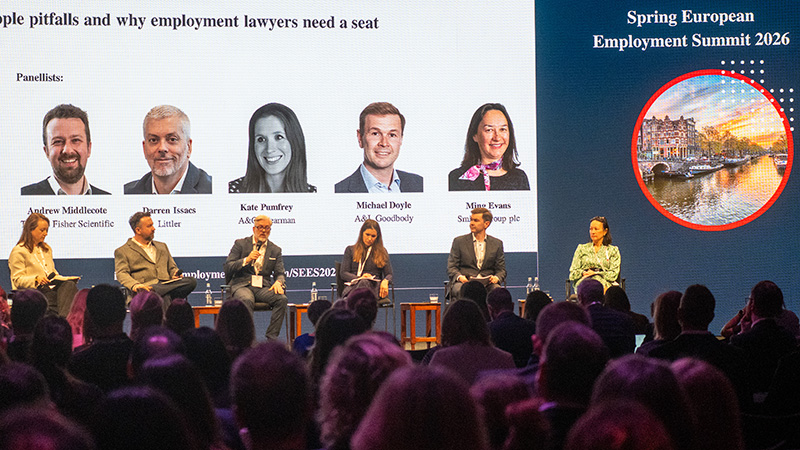
ALG was once again a gold sponsor of the IEL Spring European Employment Summit in Amsterdam on 4 March. Head of Employment Michael Doyle, together with Triona Sugrue and Jason McMenamin attended, with Michael Doyle participating in a panel on M&A people-related challenges and the strategic role of employment lawyers.
Pay Transparency Hub
Keep track of all the latest developments on gender pay gap reporting and pay transparency. Our hub contains lots of information and guidance on how your organisation can comply with gender pay gap reporting and prepare for the upcoming implementation of the EU Pay Transparency Directive. View hub.